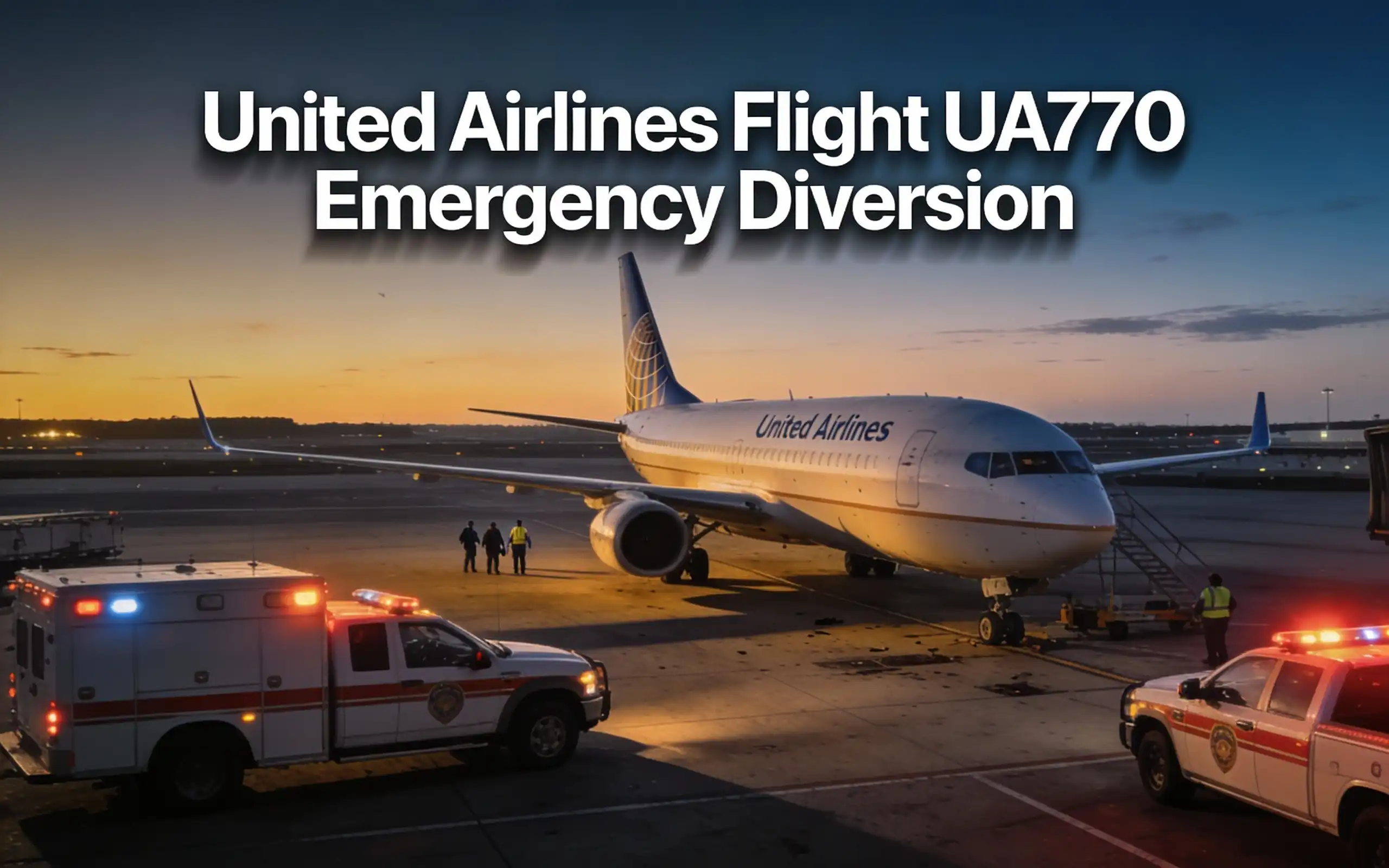
Emergencies during air travel illustrate how quickly things can spiral out of control, and how quick actions can save lives. The United Airlines flight UA770 emergency diversion in 2025 offers key lessons for car safety tech, too. This case exemplifies the importance of real-time assessments and the need for calm decision-making during turbulence.
What Happened on United Airlines Flight UA770 Emergency Diversion
The United Airlines Flight UA770 took off from Barcelona and started the May 27, 2025, flight to Chicago on a Boeing 787-9 Dreamliner. The crew received alerts about the cabin pressurization problems an hour into the flight, and the issue impacts the air in the plane at high altitudes. The crew declared an emergency with code Squawk 7700.
The pilots chose and emergency diverted to London Heathrow, an airport which is nearby and always ready for such emergencies. The plane landed successfully, with the 257 passengers unharmed, and emergency responders were there waiting for them. Nobody got hurt because of the excellent training of the crew and the added safety systems on board that detected the issue early.
Reports from July to November of 2025 show no significant injuries during the flight, nor were there any issues afterwards. United Airlines inspected the aircraft and allowed passengers to continue traveling a short time later.
Key Reasons for the Diversion
An aircraft diversion takes into account a number of factors, but the main component is the technical notification of the pressurization subsystem, which is vital for providing safe cabin air at 35,000 feet.
The warning was detected mid-flight, leading to the need for verification. Details remained confidential; however, the situation was similar to previous incidents involving sensor malfunctions or loss of cabin pressure.
The crew carried out the steps of assessing the risk, notifying the air traffic controllers, and determining the optimum crash location. This illustrates the extent to which the onboard computers assist the pilots in making rapid, unimpeded decisions. Weather, among other factors, was not to blame; this was a typical breakdown of the system.
Actions of the Crew and Passengers
The crew remained professional, keeping the passengers informed and adhering to the protocols. They completed their checklists, prepared the cabin for landing, and reassured everyone with systematic briefings. The passengers were aware of the landing and the rapid descent, but they trusted the crew, and even applauded when the crew landed the airplane.
Always calm crew members, effective training, and the ability to identify threats in real time are the attributes that enabled this situation to remain risk and stress free.
Aviation and Automotive Safety
Like aviation, cars have the unexpected, like a fast tire burst or a broken brake. The United Airlines Flight UA770 emergency diversion is the same as self-driving car flaws and is the same as aviation. Both must have a system that detects dangers ahead in order to avoid a crash and provide real time information.
In cars, the plane alerts are like ADAS, which stands for Advanced Driver Assistance Systems. These systems monitor the road and provide alerts to the driver, and even take control of the car if necessary.
Lessons fromUnited airlines flight ua770 emergency diversionwill push car makers to make these systems tougher.
Lessons for the Safety Technology in Automobiles
The main lesson from United airlines flight ua770 emergency diversion confirms the importance of rapid sensor response coupled with reliability in backups to avoid accidents.
Crew training works in conjunction with driver aids that provide guidance to make safe stops. Auto-brakes, for example, are in line with diversion plans.
The 2025 updates are evidence that car manufacturers are confirming AI is the new standard, including Tesla’s new sensor health monitors. These systems, like commercial aviation, are designed to forecast and prevent failures.
Comparative Analysis: Aviation & Automotive Systems
| Aspect | Aviation (UA770 Example) | Automotive Safety Systems |
| Detection Method | Cabin pressure sensors, real-time alerts | Cameras, radar, tire pressure monitors |
| Response Time | Minutes to divert and land | Seconds for auto-brake or lane assist |
| Backup Systems | Redundant engines, auto-pilot failover | Dual radars, manual override options |
| Human Role | Trained pilots decide after data | Driver confirms or system auto-handles |
| Post-Incident Check | Full probe, software updates | OTA updates, recall checks in 2025 |
This table summarizes the strengths and weaknesses in the given systems. While aviation is the clear winner in redundancy, automotive systems are expected to match aviation standards with the 2025 advancements.
2025 Anticipated Advancements in Automotive Technology
The new regulations in the aftermath of events like United Airlines Flight UA770 Emergency Diversion are designed to provide stronger fail-safes. The EU and US are advancing sensor fusion, the combination of lidar and radar, to ensure reliable detection.
The new over-the-air updates will drastically reduce software patch downtime in vehicles, similar to the updates in aircraft following the probes. In 2025, GM will release engine monitors that will provide advanced warning of vehicle issues.
The ability of AI to forecast failures using similar patterns from aviation will reduce the need for diversions, or road stops by __% in previous assessments.
Creating More Resilient Systems
Cars need to be built with a layered structure: primary human inputs, backup systems, and manual overrides. UA770 demonstrates that a single alert chain can avoid catastrophic results.
Testing will be conducted under real stress, like airplane simulators. Two thousand twenty-five regulations will require this for Level 3 autonomy.
Quickly spot trends by sharing information across companies in the aviation industry.
Real-world examples with cars
Ford’s Blue Cruise has multi-sensors for safe hands-free driving, like the UA770s. It circumvented a test error in the 2025 trials.
Volvo’s 2025 safety suite auto slows under pressure like a warning, pulling from air lessons.
These reduce incidents by spotting issues early, just like in the sky.
Steps for Safer Roads Ahead
- Budget for more backups for all users.
- Use apps for driver training on the limits of the systems.
- Yearly sensor checks should be mandated, like with planes.
- Use AI for fleet-wide alerts on faults.
Takeaway: Increasing road safety for everyone is attainable by incorporating layered safety measures, training, and technology updates from UA770.
Conclusion
United Airlines Flight UA770 Emergency Diversion teaches that while some surprises are unavoidable, innovative technology and calm operational control can mitigate unforeseen problems. With the right technology and quick modifications, more lives can be saved. As advancements in technology are predicted for the year 2025, road safety will be able to match the level of safety in the sky.
Remain vigilant, recognize the capabilities of the technology, and advocate for modifications — safety begins with the lessons that have been acknowledged. While the emergencies that arise in air travel demonstrate the urgency with which problems can escalate, the prompt implementation of specific solutions can be life-saving. The Diversion of United Airlines flight UA770 in 2025 demonstrates the real-time application of modern car safety technology. It also emphasizes the importance of calm decision-making in moments of elevated risk.
For Regular Update Visit The Instander Official